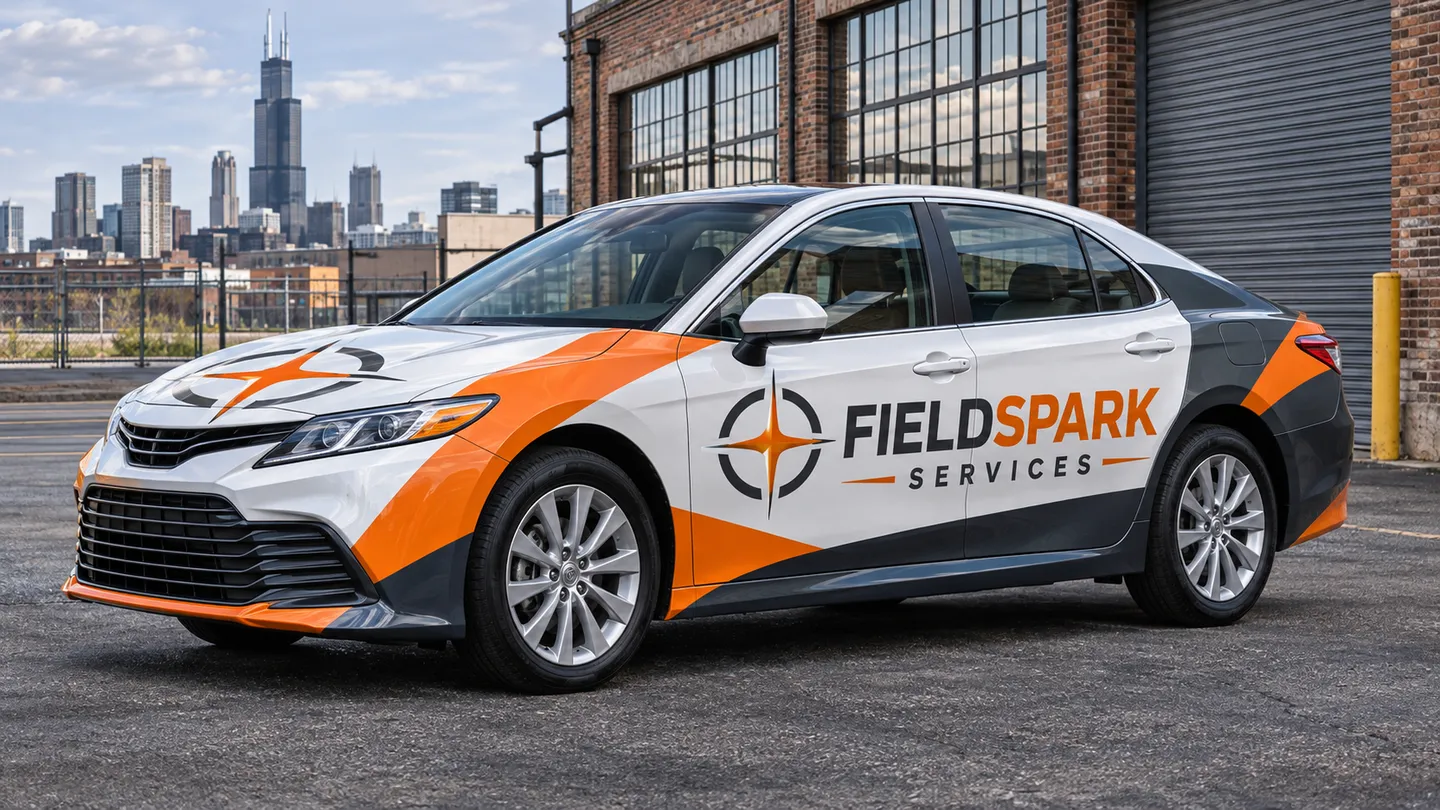
Define the business role
Write down who drives the car, where it is normally seen and whether the public should contact the company from the graphics. A sales representative’s car and a pool car can need different emphasis even when the underlying business identity is shared.
Decide whether the vehicle should communicate a broad company name or a specific service. Avoid treating the body as an extra business card that must contain every contact method. The designer needs a priority order that can survive the actual panel shapes and available space.
- Describe the normal driver and vehicle use.
- Choose the primary message before the service list.
- Confirm the contact route the business can maintain.
Review the body in separate views
Photograph both sides and the rear with the car level and fully visible. Note trim, badges, handles, sensors and any paint or body repairs. A company-car brief should identify the year, model and relevant body variant rather than relying on an image of a similar car.
Compare focused logos, lettering and broader coverage using those photographs. Keep essential information away from areas that are routinely obscured or broken by body details. A design proof explains the proposed appearance, but the installer still needs to review condition, dimensions and material suitability.
- Review side and rear hierarchy independently.
- Record equipment and body details affecting placement.
- Identify exposed paint as part of partial graphics.
Keep ownership and handoff practical
If the car is leased, assigned to an employee or shared between departments, confirm who can authorize graphics and removal. Keep personal contact details out of the artwork unless their use is deliberate and approved. A role-based company contact may be easier to maintain when staff change.
At delivery, retain the approved artwork, installed material information and care source. Give the driver a simple route for reporting damage or lifting rather than asking them to improvise a repair. The linked manufacturer resources help locate product-specific instructions; they are not a substitute for the supplier’s actual installation record.
- Confirm authority to modify the vehicle.
- Keep approved wording separate from draft concepts.
- Provide the driver with the applicable care record.
Keep a working record
Before you approve the next step
- Record the car’s business role.
- Photograph all relevant exterior views.
- Confirm the actual body variant.
- Approve a clear message hierarchy.
- Check vehicle authorization and wording.
- Keep artwork and care information at handoff.
Use the free planning tool to organize the details you can confirm and the questions still open.
Four questions before the next step
Does a company car need a full wrap?
No single coverage level is required. Compare the identity you need, available panels, vehicle condition and accepted scope before choosing lettering, partial graphics or broader coverage.
Read the detailed guide: Choose company-car graphics around the way it is used
Can a screenshot of the logo be used?
Supply it as a reference and ask what production files are needed. A screenshot should not be treated as an approved, print-ready logo without review.
Read the detailed guide: Choose company-car graphics around the way it is used
Can photos replace a physical inspection?
They help identify the vehicle and open questions. Surface condition, fit, dimensions and installation suitability may still need confirmation on the actual car.
Read the detailed guide: Photograph the company car so the quote starts with evidence
Should I mark dimensions on an image?
You can record verified measurements with units and reference points. Label estimates clearly and do not present a guessed dimension as production-ready evidence.
Read the detailed guide: Photograph the company car so the quote starts with evidence
Original technical sources
Use the linked publisher's current instructions for the exact product and vehicle. This planning guide does not replace its application, safety or warranty requirements.